- Género
- ARTE - Danza
- ISBN
- 978-9878552743
- Páginas
- 216
- Formato
- 14.5 cm x 21 cm
- Colofón
- marzo de 2026
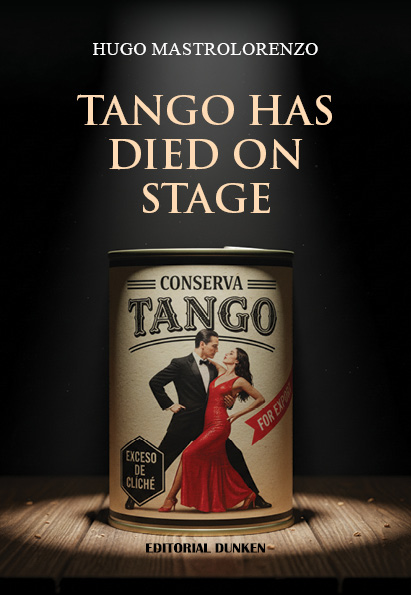
Tango Has Died on stage
Could we define the current tango scene as art, or as aestheticized entertainment?
Is the current scene alive, or has it already died?
When and why did the stage representation of tango dance emerge? When and why did social tango, milonga exhibitions, and tango-for-export take shape? When did the iconic images that crystallized the tango scene come into being?
A dystopian narrative about a robotized, cloned tango. In parallel, a journey through the history of tango in its various spaces of representation—a research-based critical essay that examines tango on stage from both an insider’s and an outsider’s perspective.
You enter the stage; the space is empty.
You pause for a moment… questions hunt you:
What am I going to do? No—the space is not empty; it is full of clichés,
of worn-out movements, of eroded gestures that others have inhabited hundreds of times,
and that you borrowed long ago to be part of this community.
The ritual of the stage begins: we stand before the audience, a tango starts to play…
Hugo Mastrolorenzo developed a notation system, a teaching method, and a new theory about the origin of tango. His books have been highlighted by the press as “one of the sharpest contributions to the genre.” A provocative choreographer, he succeeded in forging his own language, expressing a renewed conceptual perspective. He has taught classes and performed on the most emblematic stages of Argentina and in dozens of cities across Europe, America, and Asia. World champion in tango dance, together with Agustina Vignau, he received the highest rating from three jury members, achieving the most extraordinary score in the history of the world championships. He received the Min-On Concert Association award from Japan, the distinction from the Chamber of Deputies of the Argentine Nation, the Tango Prize for his work “Volá,” and the “Ambassadors of Tango” award, sponsored by UNESCO, Pro Tango, and the Presidency of the Argentine Nation. Some media outlets claim his greatest achievement lies in his research contributions to the genre, while others maintain his greatest merit is breaking traditional paradigms of stage tango.
También de este autor



Libros que te pueden interesar